Learning as a Senior Frontend Engineer (Without Burning Out)
Learning frontend development looks very different depending on where you are in your career.
What motivated me as a junior is not what motivates me today as a senior - and that shift didn’t happen overnight. It came from working in larger systems, making mistakes, revisiting fundamentals, and realizing that being up to date is not the same as being effective.
This post is about how my approach to learning has evolved over time, and how I try to stay sharp today without turning learning into pressure or burnout.
How my learning mindset evolved over time
Early in my career, learning was tightly coupled to delivery.
As a junior, my focus was simple:
Do the task well, do it on time, and do my part as best as I could. I learned what I needed in order to complete the work in front of me.
As a mid-level engineer, the scope widened. I started caring much more about:
- consistency across the codebase
- readability
- reusability
- understanding more of the product context
Learning became less about isolated tasks and more about writing code that fit into a larger whole.
Now, as a senior, the perspective is broader still.
When I work on a feature, I constantly ask myself:
- Will this be easy to understand in 3–6 months?
- How will this affect maintainability?
- What does this mean for onboarding new team members?
- Does this improve or hurt developer experience?
Learning today is inseparable from thinking about the future.
Being selective in a noisy ecosystem
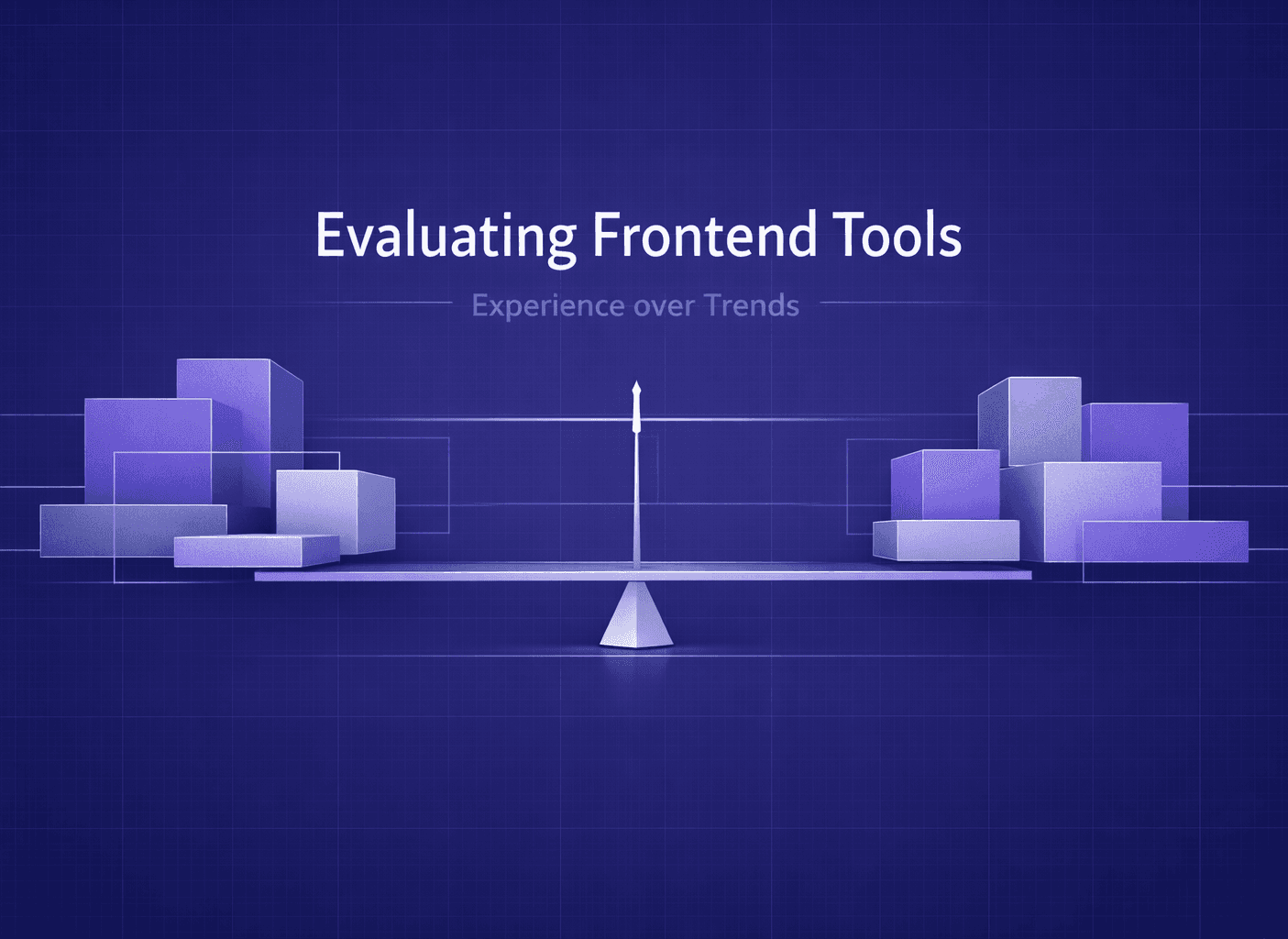
Frontend moves fast - sometimes too fast.
At this stage, I consciously avoid chasing every new tool or trend. Instead, I try to deeply understand the tools I already use:
- why they exist
- where they shine
- where they fall short
If I encounter problems with them, I’m more interested in understanding why than immediately replacing them. That depth makes it much easier to evaluate new solutions when they appear.
Sources I keep coming back to
Over time, I’ve learned to trust people and platforms, not algorithms.
Some sources I consistently return to:
- Maximilian Schwarzmüller - for solid fundamentals, structured thinking, and thoughtful takes on the future of web development
- Sonny Sangha - for practical overviews of new tools and when they make sense
- Fireship - for concise, high-level updates on the ecosystem
- Medium - for comparisons, trade-offs, and opinionated perspectives
- daily.dev - to stay loosely in the loop without deep commitment
- JavaScript Mastery, Web Dev Simplified, Zero to Mastery - depending on the topic
If I see similar ideas echoed across people I respect, I pay attention.
How I filter what’s worth my time
I decide very quickly whether something is worth deeper attention.
Signals I look for:
- Clear explanation of trade-offs
- Real-world use cases, not just demos
- Honest limitations
- Alignment with problems I actually face
I’m also cautious with paid partnerships. I don’t dismiss them outright - but I treat them as data points to compare, not conclusions to accept.
Fundamentals I keep revisiting
Interestingly, the more senior I become, the more I return to the basics.
Things I consciously reinforce:
- JavaScript fundamentals
- frontend and system architecture
- performance and web vitals
Strong fundamentals make new tools easier to understand - and easier to ignore when they’re not relevant.
Learning through real work
Most of my learning today happens inside real projects.
It comes from building complex features, debugging tricky issues, reviewing code, production incidents, and discussions with teammates that challenge how I approach problems.
Those moments often teach me more than any course or video.
Guardrails against burnout
One important shift I made was letting go of the idea that I need to know everything.
I no longer force myself to:
- keep up with every new release
- experiment with tools just because they’re popular
- feel behind if I don’t try something immediately
Instead, I focus on tools that have matured enough to be useful - and learn them when there’s a real opportunity to apply them.
Depth over breadth
Earlier in my career, I benefited from staying broadly aware of many tools.
Smaller projects gave me room to experiment.
Today, working in a large, long-lived codebase, depth matters more.
Understanding fundamentals deeply has proven far more valuable than shallow familiarity with many tools.
What I’d tell my junior self
If I could give my junior self one learning rule, it would be this:
Don’t overwhelm yourself with everything new.
Invest in the basics - they’ll help you understand the rest in minutes.
Senior-level takeaway
At senior level, learning is less about hype and fluff,
and more about building deep expertise in the fundamentals that support everything else.
That mindset makes learning sustainable - and far more effective over the long run.
Conclusion
Staying curious still matters.
But so does restraint.
The goal isn’t to know everything - it’s to build judgment, context, and confidence over time.
That’s the kind of learning that compounds.