What Building with Strapi Taught Me About CMS‑Driven Frontend Architecture
CMS‑driven frontends look deceptively simple from the outside.
Content updates without deployments. Pages created without code changes. Structure managed through an admin panel.
But once content truly controls the system, frontend architecture changes fundamentally.
This post reflects on what I learned building content‑heavy projects with Strapi, using a JAMStack setup with Next.js, Tailwind CSS, and Strapi’s API and admin panel - and how that experience reshaped how I think about frontend architecture, constraints, and ownership.
When content becomes the system
The first real realization came early:
When content controls everything, frontend architecture has to be designed for it from the very beginning.
Routing, rendering, layout, and error handling all shift. You’re no longer building pages - you’re building a system that renders intent defined elsewhere.
That requires discipline:
- reusable templates instead of one‑off layouts
- predictable sections and components
- clear contracts between CMS data and frontend rendering
Without that structure, flexibility quickly turns into chaos.
Content modeling is where complexity starts
One of the hardest lessons was learning that content modeling decisions echo everywhere.
Things like:
- section ordering
- visibility toggles
- weights and priorities
All seem harmless in a CMS - but they directly impact frontend complexity. Every new option multiplies rendering paths, edge cases, and testing surface.
Good content models don’t maximize flexibility.
They balance expressiveness with safety.
Limiting flexibility on purpose
A key architectural decision was intentionally limiting freedom.
I did this through:
- predefined templates
- section‑based layouts with fixed visual rules
- frontend‑controlled rendering logic
One especially valuable feature was draft preview from CMS to frontend.
Content managers could preview pages before publishing them publicly - reducing mistakes and increasing confidence without exposing unfinished content.
Constraints weren’t restrictive - they were protective.
How CMS‑driven architecture reshapes frontend work
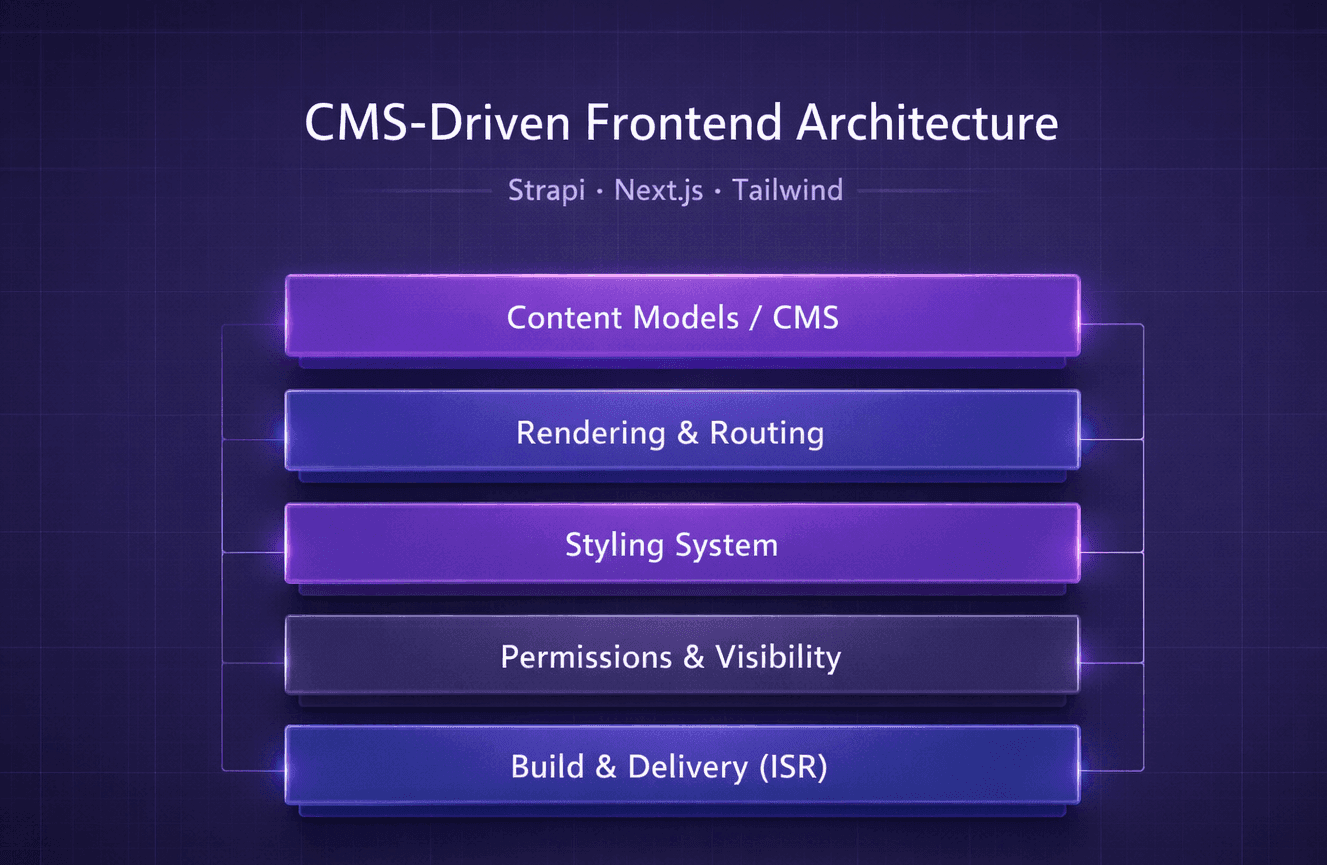
A CMS‑driven system changes almost every frontend concern:
Component design
Instead of building components for pages, I built sections with clear design intent - meant to be reused, reordered, and composed safely.
Routing
Routes were fully dynamic, fetched from the API and resolved using Next.js [slug] patterns. The frontend didn’t “own” routes anymore - it interpreted them.
Data fetching & stability
Error handling became critical. The frontend had to be resilient to incomplete, misconfigured, or evolving content - without breaking the experience.
Rendering strategy
Using ISR, the most recent pages were prebuilt and cached, while updates triggered regeneration. This allowed the system to scale content without rebuilding everything.
The frontend stopped being static code and became an adaptive runtime.
Permissions, visibility, and user trust
CMS‑driven permissions reinforced an important lesson:
Authorization isn’t just backend logic - it directly shapes frontend UX.
What users can see, what’s hinted at, and what’s hidden all affect trust.
That required:
- clear frontend constraints
- explicit role‑based visibility
- avoiding accidental exposure of structure or intent
Good permissions design feels invisible - but its absence is immediately noticeable.
Developer experience: trade-offs in practice
Strapi made life significantly easier as a sole developer.
The API and admin panel out of the box enabled real momentum.
That said, customization comes with a cost:
- understanding internal abstractions
- navigating a powerful but complex system
- adapting to opinionated defaults
For me, the trade‑off was worth it.
The community - especially Strapi’s Discord - played a big role. Sharing patterns and solving problems together improved both DX and confidence.
What I would do the same today
If the requirements were similar, I would make many of the same choices:
- JAMStack architecture
- Next.js for rendering
- Strapi as the CMS
- clear frontend constraints
The overall experience leaned far more positive than painful.
What I’d approach more carefully
What would change is not ambition - but restraint.
Today, I’d be more careful about:
- over‑engineering early abstractions
- adding flexibility before it’s needed
- solving hypothetical problems too soon
Simplicity scales better than cleverness.
Senior-level takeaway
CMS‑driven projects succeed or fail based on understanding the client’s real needs and the responsibility that comes with flexible systems - not because of the tool itself.
The CMS is never the architecture.
It’s just one part of it.
Conclusion
CMS‑driven frontends demand more from frontend engineers - not less.
They require architectural thinking, clear constraints, and empathy for both content creators and future developers. When done well, they enable systems that grow without constant code changes.
When done poorly, they amplify complexity silently.
Learning to tell the difference was one of the most valuable lessons this kind of project taught me.